
Stock Split vs Bonus Shares: Real Wealth Creation vs Psychological Illusion for Indian Investors
- Valuenomy Research
- Valuation Guides
- 10 Sep, 2026
Every time there is a stock split or bonus issue announcement from the National Stock Exchange of India (NSE) or the Bombay Stock Exchange (BSE), retail investors are quick to buy the stock. But every Indian individual market participant must understand the fundamental difference between a stock split and bonus shares — the former being just a notional increase in the number of shares against one’s existing holdings while the latter is an actual transfer of value from a company’s profit reserves to new share issuance.
Both corporate actions are purely notional because neither adds value to the business, nor improves the core earnings power or profit-earning potential of the underlying enterprise.
This article will explain, for a young investor, the real-life accounting, legal, and taxation details behind the scenes of a stock split versus bonus shares so that a market participant is able to distinguish between a free lunch versus psychological value creation.
Stock Split Mechanics
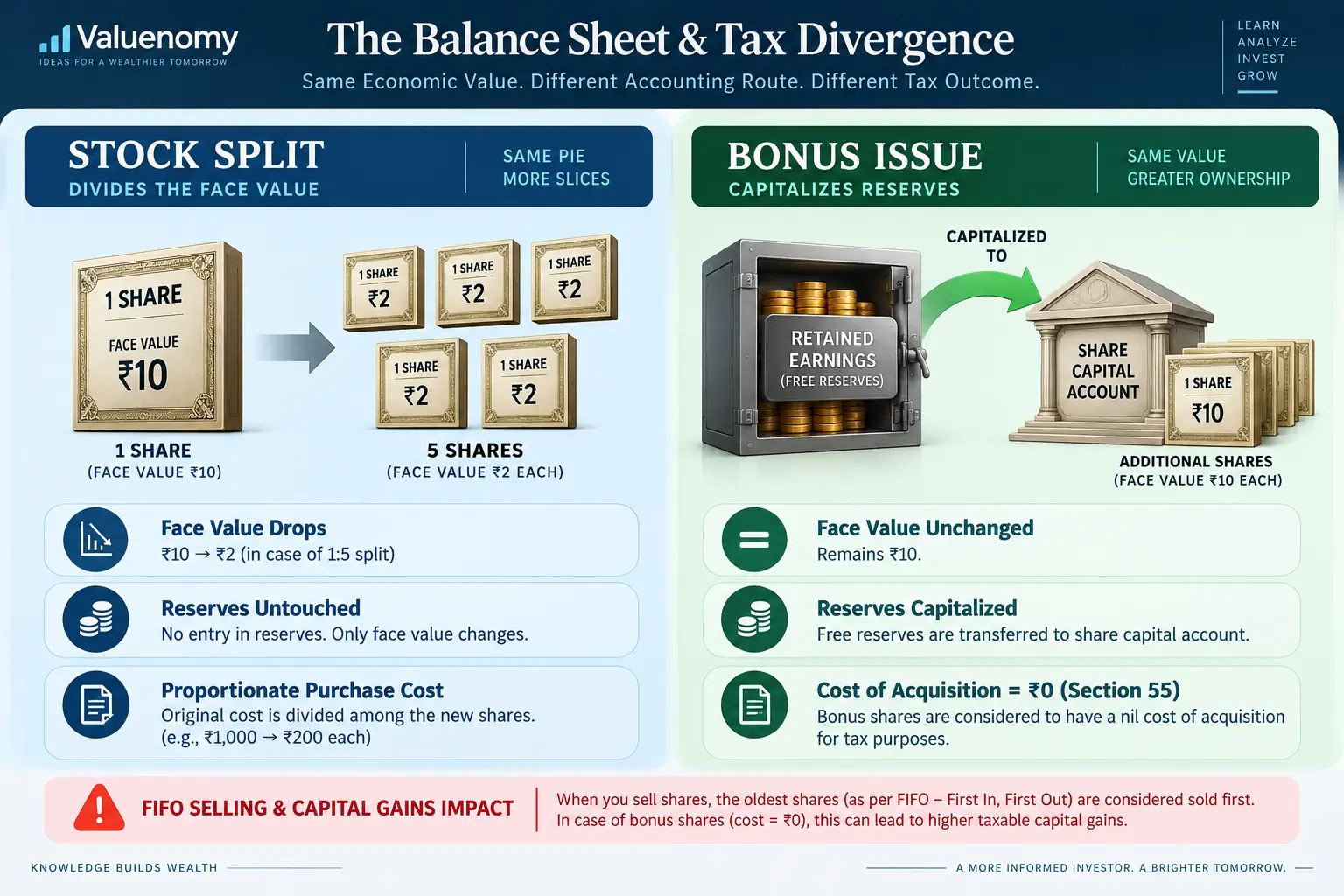
A stock split is a reduction or expansion of the face value of a share of a company against a background of one’s existing holdings.
Indian companies typically have common equity shares as the default category of shares. Every stock in India has a face value of ₹10, ₹5, ₹2, or ₹1.
The calculation for a stock split is:
Post-split shares = Pre-split shares * (Old face value / New face value)
Example:
Assume you buy 100 shares of a stock whose market value is ₹2,000 at a face value of ₹10. The board of directors decides to announce a 1 for 5 split – i.e., the face value reduces by 5x.
Your revised holdings would be 500 shares at a face value of ₹2 and a revised market value of ₹400.
Impact on Balance Sheet
A stock split does not affect the reserves account in the net worth of a company. Before a 1 for 5 stock split, the balance sheet of the company will look like this:
- Share capital: 1 crore shares at ₹10 face value = ₹10 crore
After the stock split announcement of 1 for 5, the balance sheet will show:
- Share capital: 5 crore shares at ₹2 face value = ₹10 crore
There is no change in retained reserves, free reserves, securities premium, and shareholder’s fund. The total net worth and shareholder’s fund remain the same.
Bonus Share Mechanics
Companies are allowed to capitalize free reserves and profit reserves against a background of their existing share capital. According to Section 63 of the Companies Act, 2013, a company can issue fully paid-up bonus shares to equity shareholders from:
- Free reserves built from cash profit
- Securities premium account
- Capital redemption reserve account
Bonus shares cannot be issued out of revaluation reserves of assets.
Example:
Assume a company issues bonus shares in a 1 for 1 ratio and an investor owns 100 shares at ₹2,000. The face value of these shares will remain the same, say, ₹10. But the company will have to debit ₹10 per new share issued from its profit reserves account and credit the new share capital account with ₹10.
Impact on Balance Sheet
- Retained earnings / Free reserves reduce by ₹10 for every 1 new share issued in bonus.
- Issued share capital increases by ₹10 for every 1 new share issued in bonus.
Comparison Table
| Underlying Basis | Stock Split | Bonus Issue |
|---|---|---|
| Reason for action | Sub-division of nominal share capital | Capitalization of profit reserves |
| Face value of share | Face value reduces in proportion to the split ratio | Face value remains the same |
| Impact on free reserves and surplus | No change | Reduced by ₹10 for every 1 bonus share issued |
| Impact on paid-up equity share capital | Paid-up equity capital remains the same because higher number of shares balance lower face value | Increases by ₹10 for every 1 bonus share issued |
| Impact on corporate net worth | Remains the same | Remains the same |
| Impact on Earnings per Share (EPS) and P/E multiple | EPS reduces in proportion of increase in share capital; P/E multiple remains the same | EPS reduces in proportion of increase in share capital; P/E multiple remains the same |
| Primary objective of company | Reduces market price for easier retail trading | Repayment of profit reserves as a form of reward to the shareholders |
The Psychological Illusion: Why Investors Buy Stocks at Split Announcements
The primary reason behind why investors buy the stock on the back of a stock split or bonus issue announcement is the nominal price illusion in the market.
If the stock is trading at ₹5,000, and it splits on a 1 for 10 ratio to become available at ₹500, the retail public will feel that it is a steal. The individual investor will erroneously compare the absolute value of the price before and after the split. The reality, however, is that the absolute value of the share price being lower does not necessarily make a stock a good buy.
Think of a 12-inch pizza slice. If you divide the entire 12-inch pizza into 4 equal slices and buy 2 of them, you would have exactly half the food as compared to slicing the entire pizza into 16 equal slices and buying 8 of them — in both cases you end up eating the same amount of food.
Similarly, if a company is posting a net profit of ₹100 crore and has 1 crore shares outstanding, its Earnings Per Share (EPS) will be ₹100. If the market value of the stock is ₹1,500, its Price-to-Earnings (P/E) ratio would be 15.
If the firm announced a bonus issue of a 1 for 1 ratio, the EPS would be reduced to ₹50 as there will be 2 crore shares outstanding. The P/E ratio would remain the same at 15 — this means that the price of the stock would also reduce to ₹750. The absolute value of the stock has reduced, but the intrinsic business value of the company remains the same.
The only way to ascertain if a stock is fairly valued after a stock split or bonus issue is to analyze its valuation metrics using our Fair Value and Stock Target Calculator.
The Tax Trap: Difference in Capital Gains Taxation
While the business economics of a stock split and bonus shares is identical, their taxation treatment differs drastically when you decide to sell your shares.
Taxation Treatment of Stock Splits
When a stock undergoes a split, capital gains taxation in India treats it as the same share being traded in the market but carved out into more shares.
- Cost of Acquisition: The value of your original cost of purchase is spread out over the total number of shares against your original position size.
- Period of Holding: The period of holding of the original shares applies to your entire new position size.
Example:
You purchased 100 shares of a stock at ₹1,000 on 1 January 2024. On 1 August 2024, the stock announced a 1 for 5 stock-split. Now you have 500 shares. The cost of acquisition will be ₹200 for every new share (₹1,000 divided by 5). If you decide to sell the shares in February 2025, your period of holding will begin from 1 January 2024. Since it is over 12 months, it will be treated as a Long-Term Capital Gain.
Taxation Treatment of Bonus Shares (Under Section 55(2)(aa))
Careful analysis is warranted when it comes to bonus shares as there are asymmetries in their taxation treatment.
- Cost of Acquisition of Bonus Shares: Under Indian Income Tax law, the cost of acquisition of bonus shares is Nil (₹0).
- Cost of Acquisition of Original Shares: Your original shares’ cost of acquisition remains the same as your initial purchase price.
- Period of Holding for Bonus Shares: Your period of holding for bonus shares does not start from the date of purchase of original shares. Rather, it begins on the exact date of allotment of bonus shares.
Example:
You purchase 100 shares of a stock at ₹2,000 on 10 October 2024. The stock announces a 1 for 1 bonus issue on 10 April 2025. The market price after the bonus issue is ₹1,000. On 1 May 2025, you decide to sell 100 of your 200 shares at ₹1,050:
Case A: Selling Original Shares
- Sale value: ₹1,05,000 (100 × ₹1,050)
- Cost of purchase: ₹2,00,000 (100 × ₹2,000)
- Holding period: Short-term (Less than 12 months)
- Tax result: Short-Term Capital Loss of ₹95,000, which can be offset against other taxable capital gains.
Case B: Selling Bonus Shares
- Sale value: ₹1,05,000 (100 × ₹1,050)
- Cost of purchase: ₹0 (by law)
- Holding period: Less than 1 month (since allotment)
- Tax result: Short-Term Capital Gain of ₹1,05,000, and you will have to pay Short-Term Capital Gains Tax on the entire amount.
Since Indian stock exchanges and depositories (CDSL and NSDL) apply First-In, First-Out (FIFO) accounting, you will always have your oldest shares considered sold first as opposed to your latest shares bought. If you are a market participant who is thinking of selling post-bonus shares, you can use our Capital Gains Tax Calculator to estimate your exact tax liabilities and post-tax returns.
When Do Splits and Bonuses Create Genuine Long-Term Wealth?
Since splits and bonuses do not add value to a stock or increase the net worth of a shareholder on the day of announcement, why do iconic companies like Reliance, Infosys, and TCS declare splits and bonus shares repeatedly over decades?
Genuine long-term value creation takes place if the company has more cash profits and can increase its cash dividends per share or its cash EPS grows after the corporate action.
1. Growth of Dividend Payments
Dividends in India are declared and paid on a per-share or face value basis.
Assume a stock has a face value of ₹10 and the company declares a dividend of ₹20 for every share. If you purchase 1,000 shares of this company, you will earn ₹20,000 every year as a dividend.
Now assume that a 1 for 1 bonus share gets issued. The new face value of your 2,000 shares continues to be at ₹10. The company continues to grow its underlying profitability and declares the same dividend of ₹20. Your annual dividends have now increased to ₹40,000 — the additional wealth accrues because its underlying business performance continues to grow.
2. Liquidity Improvements
There are times when stocks get very expensive (say a stock is priced at ₹20,000 or ₹50,000). Such stocks do not get traded actively by retail traders and the bid-ask spreads widen. A stock split makes the share price more accessible to retail participation and also reduces trading costs. This reduces market impact cost for systematic investment plan (SIP) allocations and mutual funds.
3. Confidence from Management
Bonus shares help management lock up their own reserves. When management takes money out of free reserves to issue bonus shares, it reduces its ability to call for special dividends or distributions. In a way, a bonus issue acts as a management confidence signal that its operational cash flows will sustain the increased level of capitalization.
Actionable Checklist for Investors
When a company in your portfolio announces an impending corporate action:
- Do not buy for split or bonus: Never buy a stock just because a split or bonus issue is announced, as the stock will typically see a speculative run-up ahead of the ex-date and correct immediately thereafter.
- Watch out for FIFO ordering: If you are going to sell some of your holdings post-bonus issue, check your FIFO ordering so that you do not end up triggering unexpected short-term capital gains tax on zero-cost bonus shares.
- Recalculate your true average price: After splits or bonus issues, investors often lose track of their real average purchase price if they buy on dips post-corporate action.
Stock splits and bonus shares are not magical tools to create value overnight. True value creation over the long term comes from superior returns on capital, competitive moats, and operational cash generation.
Statutory References & Institutional Sources
- Income Tax Department of India: Section 55(2)(aa) — Meaning of Cost of Acquisition for Capital Assets
- Ministry of Corporate Affairs (MCA): Section 63 of Companies Act, 2013 — Issue of Bonus Shares
- National Stock Exchange of India (NSE): Corporate Actions Framework & FAQ for Equity Investors
- Securities and Exchange Board of India (SEBI): Master Circular on Issue of Capital and Disclosure Requirements (ICDR)
- Income Tax Department of India: Capital Gains Realization & FIFO Rules (Section 45 & Chapter IV-E)

Valuenomy Research
Capital Markets & Valuation DeskValuenomy Research Desk is comprised of certified financial analysts focusing on DCF valuation modeling, Indian direct taxation analysis, and quantitative equity risk management.
View Editorial Profile & MethodologyRegulatory Compliance & Statutory Disclaimer
The financial models, valuation projections, brokerage summaries, and target estimations presented on Valuenomy are curated solely for academic research, mathematical evaluation, and investor education purposes.
Valuenomy is not a SEBI-registered investment advisor or research analyst. Securities markets are subject to high market risks. Always review underlying corporate filings and consult an authorized SEBI-registered financial advisor before executing capital decisions.