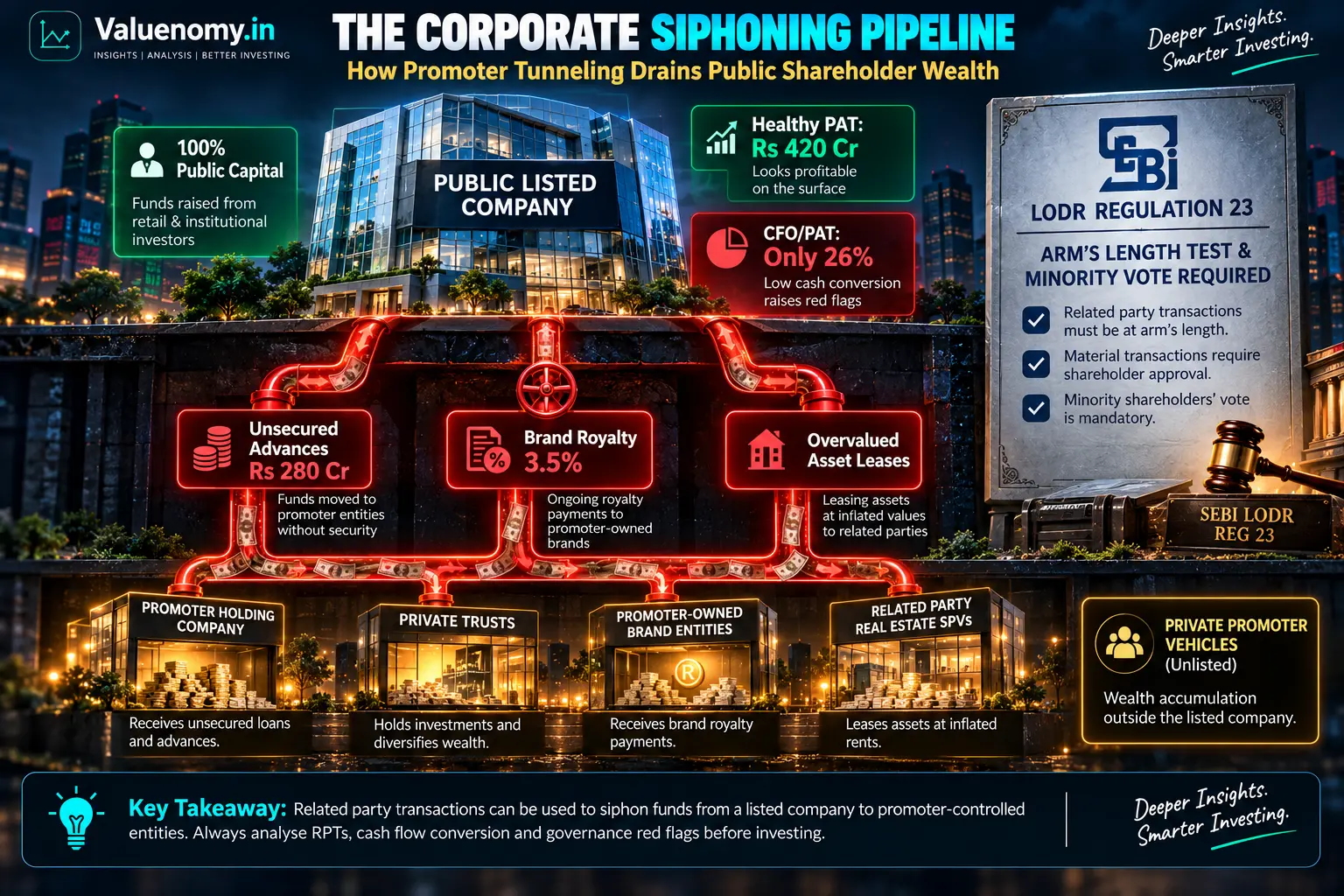
Related Party Transactions (RPT) in Indian Stocks: How Promoters Siphon Capital via Subsidiaries
- Valuenomy Research
- Valuation Guides
- 01 Oct, 2026
The Silent Drain on Minority Shareholder Wealth
RPT in stocks is a method by which promoters siphon the resources of the company, usually a listed entity, through their private companies or unlisted subsidiaries as well as connected parties.
When a company has healthy revenue growth, stable EBITDA margins, and positive EPS guidance, minority shareholders get frustrated when the cash reserves do not reflect the profitability of the company, dividends are stagnant and the cash conversion cycle shows zero or negative working capital. When forensic accountants dig into the details of such a corporate scandal, the trail of funds stops at promoter-owned subsidiaries, related parties, and shell companies.
Abusive related party transactions between an issuer company and its promoters, their private companies, unlisted subsidiaries, or other connected entities are a hotbed for value extraction activities. Technically, it falls under the umbrella of promoter tunneling and abuse of power by the controlling shareholders.
Here is an analysis of how related party transactions in Indian stocks operate across listed entities. It covers the statutory definitions of related parties, red flags to look out for in disclosures, the process of shareholder approvals, and calculation of metrics to flag anomalies.
Statutory Definition of Related Party in India – RPT
Companies Act, 2013 (Section 188) and SEBI Listing Regulations (LODR 23) cover the scope of related party transactions that need the approval of the shareholders of a listed company.
According to the Companies Act, 2013 (Section 2(76)), a “related party” includes persons having a substantial interest and private companies where a director or managerial personnel is a partner, director, or shareholder. It also includes public companies where a director holds more than two percent of the paid-up share capital.
SEBI LODR Regulation 23 has a stricter definition and covers more ground. Following the amendments introduced by SEBI in the LODR Regulations, related parties, connected parties, and the promoter group include:
- Any person or entity belonging to the promoter or promoter group of the listed company, regardless of shareholding percentage.
- Any person or entity owning or having beneficial interest in equity shares of twenty percent or more (and subsequently reduced to ten percent or more).
- Any transaction where the listed company or its subsidiary purchases or sells goods or services from or to a related party of the listed company or any of its subsidiaries.
Indian Accounting Standard (Ind AS) 24 covers the mandatory financial reporting requirements. It requires that all related party transactions, outstanding balances payable or receivable, and commitments must be itemized in the notes to the financial statements.
Four Main Methods of Promoter Tunneling Through RPT
Typically promoters don’t illegally transfer public funds directly into their personal accounts. Instead, they route them through private companies using any of the four types of related party transactions:
1. Unbilled Services, Royalties, and Brand Licensing Fees
A company records strong revenue growth even as its cash reserves do not show similar gains. The reason? A substantial portion of sales belongs to the promoter-owned private entities or unlisted subsidiaries. This is usually in the nature of royalties, technical know-how fees, or brand licensing.
These payments bleed cash from the company to the promoter group while reducing the cash available for dividends. The promoter-owned private company earns guaranteed income from the listed entity even as the latter’s equity earnings are lower due to these costs.
2. Related Party Advances and ICDs to Promoter-Owned Entities
One of the simplest methods of promoter tunneling is to create a related party transaction vehicle in the form of an unlisted subsidiary or joint venture. Even as the listed company hoards cash, the promoters transfer funds as business advances or inter-corporate deposits (ICDs) to their private concern.
Years later, the advances due as repayment from the related party are either written off as bad debts or renewed on a continuing basis without any recoveries.
3. Sole Selling or Buying Agent – Mark-Up in Procurement and Sales
A private entity owned by promoters acts as a sole agent for the purchase of raw materials and the sale of finished goods. As a result, the company purchases raw materials at fifteen percent higher prices than the prevailing market rates and sells its products at discounted rates to its promoters’ owned distributorship concern.
4. Overvalued Purchase of Capital Assets and Leasing
The promoters purchase land, intellectual property, or manufacturing units and sell it to their listed concern at prices far higher than the fair valuation as determined by an independent assessment. Similarly, corporate offices or warehouses are leased to promoter-owned LLPs at higher rates on a long-term basis.
SEBI LODR Approval Requirements for RPT
The Companies Act and SEBI LODR empower the Audit Committee of a Board to block related party transactions, particularly those that prejudice the interest of shareholders. Only independent directors appointed on the Audit Committee can exercise this power.
-
Approval by Audit Committee: Under both Companies Act and SEBI LODR, all related party transactions and their subsequent amendments require the prior approval of the Audit Committee of the Board of Directors.
-
Exemption under Arm’s Length Transaction: Under the Companies Act, if a transaction qualifies as an arm’s length transaction and the related party transaction is routine, then it does not require shareholder approval. In other words, such a deal would have similar terms and pricing as would be found between unrelated independent entities. Promoters often abuse this provision by arguing that a complex agreement is nothing but an ordinary course transaction.
-
SEBI Materiality Threshold: SEBI created a materiality threshold that is independent of whether the transaction qualifies as an arm’s length. A related party transaction is material if it exceeds one thousand crore rupees or ten percent of annual consolidated turnover, whichever is lower. Further, for brand royalties and technical know-how fees, the threshold is set at five percent of consolidated turnover.
-
Approval by Shareholders by Way of Ordinary Resolution: If a related party transaction qualifies as material under the above definition, it needs to be approved by shareholders by way of an ordinary resolution. Crucially, no related party can vote on such a resolution, even if the entity is not a party to the specific transaction.
Case Study – Comparison of Two Similar Industrial Companies
Let’s look at two comparable companies in a similar manufacturing sector. Here we compare some of the most critical financial ratios that help in identifying related party transactions in Indian stocks:
| Forensic Operating Parameter | Company Alpha (Clean) | Company Beta (Suspect RPT) |
|---|---|---|
| 3-Year Cumulative Profit After Tax (PAT) | Rs 450 crore | Rs 420 crore |
| 3-Year Cumulative Cash Flow from Operations (CFO) | Rs 430 crore | Rs 110 crore |
| CFO to PAT Ratio | 95.5% | 26.1% |
| Unsecured Loans / Advances to Subsidiaries | Rs 0 crore | Rs 280 crore |
| Royalty or Licensing Fees to Private Entity | Nil | 3.5% of turnover |
| Disclosed Related Party Receivables / Total Receivables | 2.1% | 44.8% |
| Write-offs of Related Party Advances in Past 5 Years | Nil | Rs 95 crore |
The second company in the comparison generates roughly the same revenues and profits as the first, but its cash flow from operations is barely one-third of its profit after tax, suggesting that cash is trapped in investments and loans to related parties. Company Beta’s related party receivables constitute around forty-five percent of all its trade receivables. Meanwhile, the cumulative write-off of related party advances in the last five years is ninety-five crores compared to zero write-offs for Company Alpha.
Statutory and Regulatory Resources for Reference
The institutional guidelines governing related party transactions can be reviewed at the following regulatory portals:
The Securities and Exchange Board of India (SEBI) Listing Obligations and Disclosure Requirements Regulations, 2015, Regulation 23:
The Ministry of Corporate Affairs (MCA) Companies Act, 2013, Section 188 on Related Party Transactions:
The Institute of Chartered Accountants of India (ICAI) Indian Accounting Standard 24 on Related Party Disclosures:
The National Financial Reporting Authority (NFRA) Audit Quality Review Reports:
Checklist to Spot Abusive Related Party Transactions in Stocks
If you are an analyst and want to check if an Indian company has abusive related party transactions in place, here are the systematic steps to take:
-
Step 1 – Look for Disclosures in Note 30+ in the Annual Report: Always check the notes to accounts titled “Related Party Disclosures” (mandated under Ind AS 24) in the company’s Annual Report. Specifically, look out for the total sales, purchases, and managerial compensations paid to related or connected parties. If sales or purchases to related parties cross ten or fifteen percent of gross turnover, verify the pricing terms.
-
Step 2 – Check CARO 2020 Auditor Comments: In CARO 2020, statutory auditors are required to comment under Clause (iii) whether the terms and conditions of loans and advances given to related parties are prejudicial to the interest of the company, and under Clause (xiii) whether all transactions comply with Sections 177 and 188 of the Companies Act, 2013.
-
Step 3 – Look at Cash Conversion Ratio (CFO / PAT): If you are building a financial model for a listed Indian company, calculate the five-year cumulative cash flow conversion ratio. Ideally, cash flow from operations should track or exceed PAT. If the company has negative operating cash flow or significantly lower CFO than PAT, it indicates funds being trapped in “Other Financial Assets,” “Loans to Subsidiaries,” or “Other Current Assets.”
-
Step 4 – Apply Adjustments to Value Multiples and Targets: Intrinsic value calculations or target price setups using the Valuenomy Fair Value Calculator must account for the impact of related party transactions. If a company routinely transfers cash or profits to promoter-owned entities through non-core segments, unrecoverable advances must be written off from net worth or royalties added back to recurring operating expenses.
Frequently Asked Questions
What is a related party transaction in Indian stocks?
A related party transaction in Indian stocks is a transfer of resources, services, or obligations between a listed corporate entity and its related parties (such as promoters, directors, key managerial personnel, or promoter-owned unlisted entities), regardless of whether a price is charged.
Can public shareholders vote against an RPT in an Indian company?
Yes, under SEBI LODR Regulation 23, if an RPT crosses the materiality threshold of Rs 1,000 crore or 10% of annual consolidated turnover (whichever is lower), or 5% of turnover for royalties, it must be approved by public shareholders via an ordinary resolution where interested related parties are strictly barred from voting.
What is the difference between an arm’s length transaction and an abusive related party transaction?
An arm’s length transaction is a deal between two unrelated independent entities where prices and terms mirror standard market rates. An abusive related party transaction uses distorted transfer pricing, inflated leases, or uncollected loans to systematically divert profits or corporate cash from the listed entity to private promoter entities.
How does CARO 2020 protect shareholders against related party transactions?
CARO 2020 mandates statutory auditors to report under Clause (iii) whether loans, guarantees, or advances given to related parties are prejudicial to the company’s economic interest, and verify under Clause (xiii) that proper Audit Committee and Board approvals were secured under Sections 177 and 188.
Why is payment of brand royalty to a promoter-owned entity a bad sign?
Brand royalty payments siphon recurring cash directly from the top-line revenue of a listed company into an unlisted entity owned privately by the promoter family, lowering the profit pool and reducing the distributable cash available for minority shareholder dividends.

Valuenomy Research
Capital Markets & Valuation DeskValuenomy Research Desk is comprised of certified financial analysts focusing on DCF valuation modeling, Indian direct taxation analysis, and quantitative equity risk management.
View Editorial Profile & MethodologyRegulatory Compliance & Statutory Disclaimer
The financial models, valuation projections, brokerage summaries, and target estimations presented on Valuenomy are curated solely for academic research, mathematical evaluation, and investor education purposes.
Valuenomy is not a SEBI-registered investment advisor or research analyst. Securities markets are subject to high market risks. Always review underlying corporate filings and consult an authorized SEBI-registered financial advisor before executing capital decisions.