DIVIDEND TAX RULES IN INDIA: TDS SLABS, FORM 15G AND 15H, AND TAX PLANNING EXPLAINED
- Valuenomy Research
- Taxation
- 08 Sep, 2026
Overview of Dividend Taxation in Indian Equities
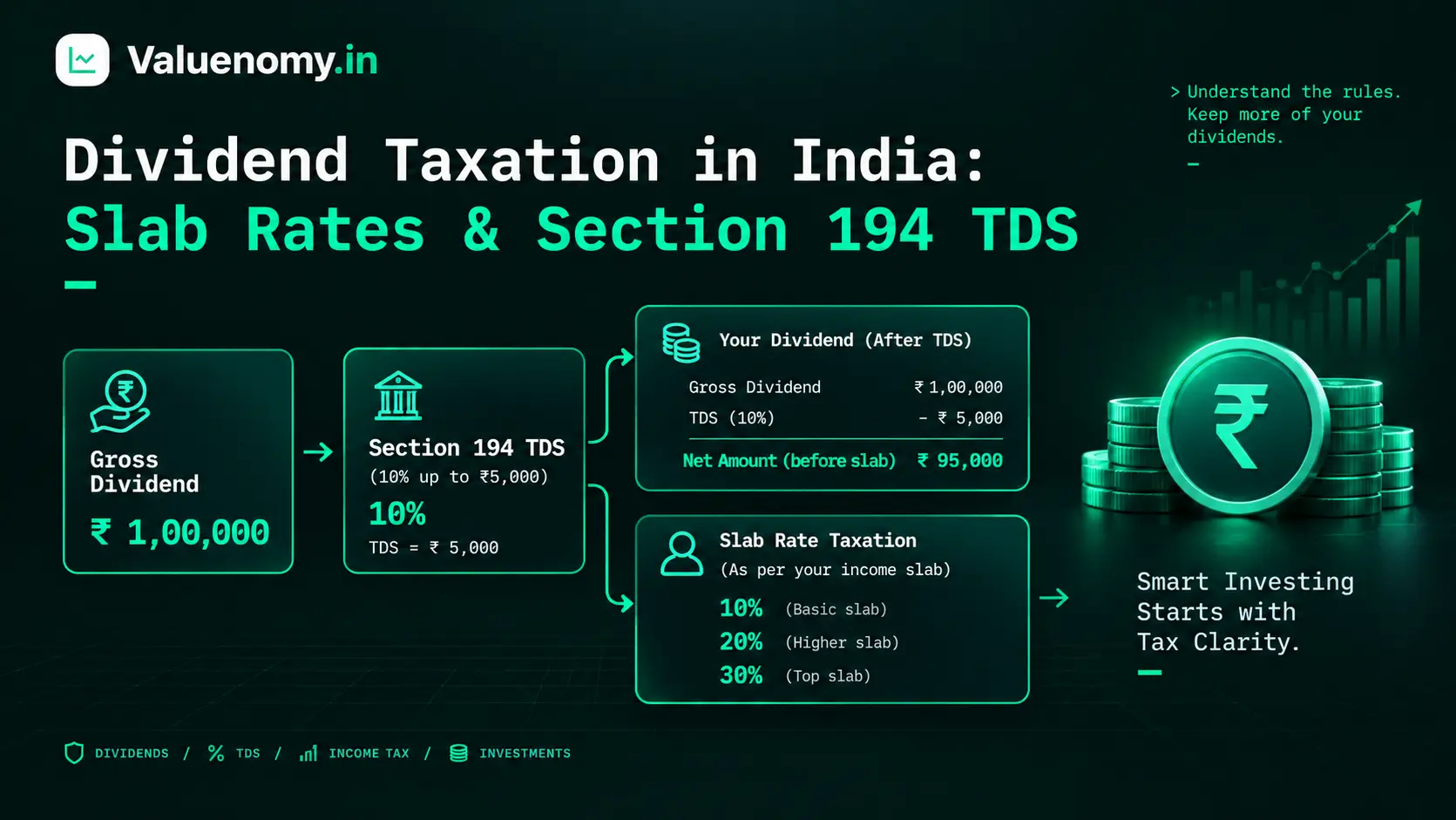
Individual investors used to receive dividends on Indian stocks and equity funds as tax-free income until the Finance Act changed the taxation rules. Previously a Dividend Distribution Tax (DDT) at the corporate level used to be enough, but now every investor needs to pay taxes in their personal capacity.
The entire amount of dividends that you receive from listed or unlisted stocks/equity funds are now treated as Income From Other Sources that is taxable under your applicable slab. Given that dividend yields are crucial to the cash flow of portfolio managers and income investors, learning the TDS slabs, Form 15G and 15H rules, and tax exemptions is paramount to optimize returns.
How Dividend Taxation Works (Slab Rate)
The Income Tax Act now subjects these dividends to slab rate taxation. That means your dividend income gets clubbed with your total income from other sources and taxed at your highest marginal slab rate.
The most important thing to understand is that your personal income dictates how much tax you will pay on dividends:
- If your income fell below the basic exemption threshold, your effective tax on dividends will be zero.
- If your total income falls in the 20% or 30% tax bracket, your dividends will be added to your income and taxed at the top slab rate, including the 4% health and education cess and applicable surcharge.
Unlike long-term capital gains that benefit from a preferential tax regime (12.5% tax on LTCG), dividend income does not enjoy any special exemptions. For higher-income investors, this can significantly reduce their total returns compared to a growth stock that delivers capital appreciation.
Track and estimate your net tax liability on equity sales using our Capital Gains Tax Calculator.
TDS Withholding Provisions (Section 194 of the Income Tax Act)
Whenever a company pays out dividends to its shareholders, it needs to withhold a portion of the dividend distribution as Tax Deducted at Source (TDS) as applicable to the recipient investor.
Here are the critical TDS rules that every equity investor needs to be aware of:
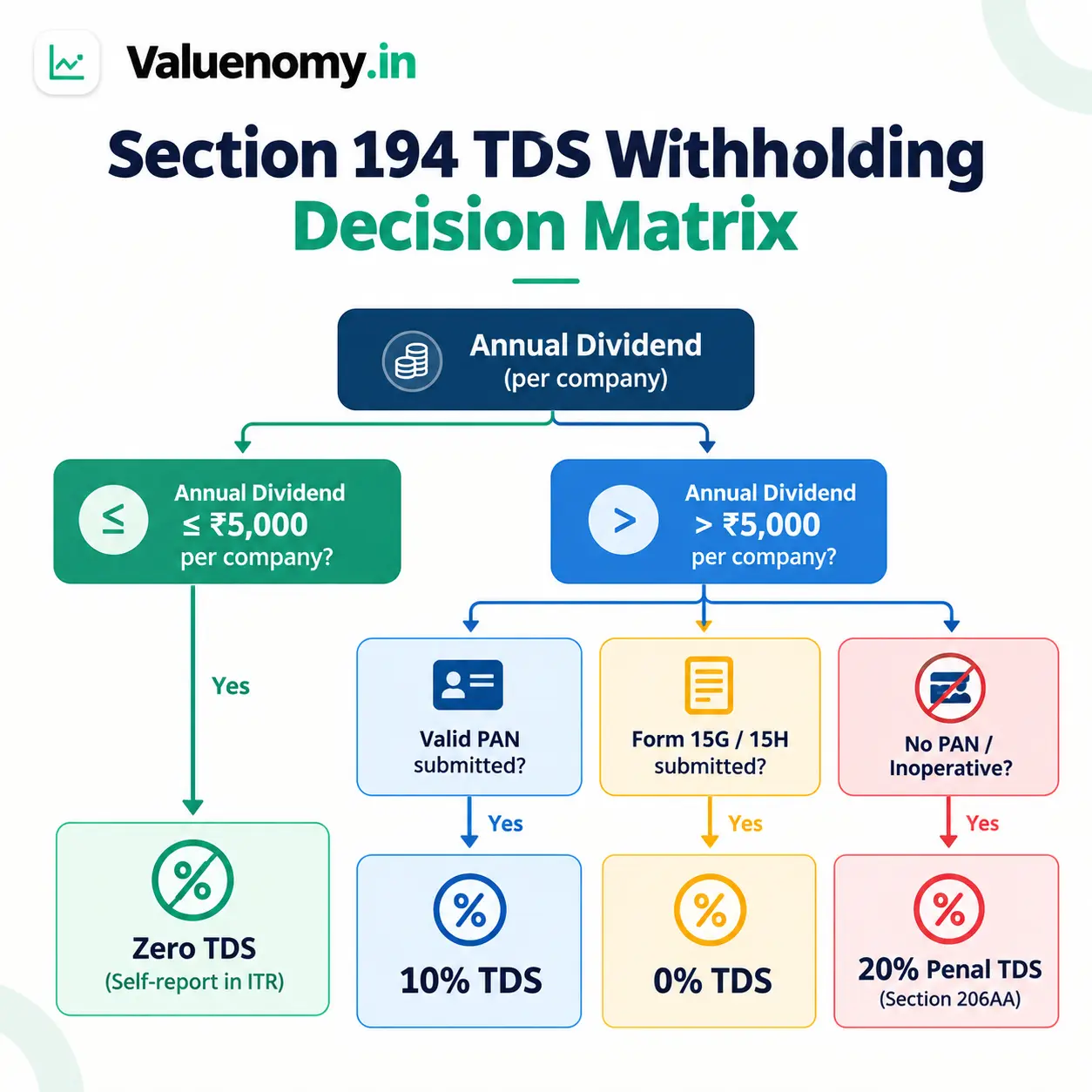
- Statutory Exemption Limit: Unless the company pays dividends to a minor or a trust, it will not withhold any amount if your total dividend from the company during the financial year does not exceed Rs.5,000/- and the payment is made by account payee cheque/demand draft or electronic payment.
- Standard TDS Rate: In case your aggregate dividend from a particular company during the year exceeds Rs.5,000/-, it will withhold 10% of the dividend as TDS, provided that the investor submits a valid PAN and it is linked with Aadhaar. If the company does not find a PAN or it is invalid, it will withhold 20% of the dividend as TDS (see Section 206AA below).
- Penalty TDS Provisions: If the company cannot verify a valid PAN of the shareholder, it will withhold 20% of the dividend as penalty TDS.
It is vital to note that the Rs.5,000/- limit applies per company. If you receive dividend from two companies – say, Rs.4,000/- from Company A and Rs.4,500 from Company B, neither of them will withhold any TDS even though your total dividend income during the year is Rs.8,500/-. However, you will need to report this Rs.8,500/- in your income tax return and pay applicable taxes.
Form 15G and 15H to Avoid TDS On Dividends
If your total income during the year is expected to be below the basic exemption limit and you are being withheld tax on dividends, it is advisable to apply Form 15G or 15H to the Registrar and Transfer Agent (RTA) or the Company itself to avoid TDS.
Form 15G is available to resident individuals below the age of 60 years and Hindu Undivided Families (HUF). The form can be submitted to the RTA (e.g., CAMS, Kfintech) or the company before the record date. There are two conditions that must be met to apply Form 15G:
- Your total estimated tax on taxable income during the year must be zero (i.e., your total taxable income is below the basic exemption threshold).
- Your total estimated dividend (and interest) income during the year must not exceed the basic exemption limit.
Form 15H is only applicable to senior citizens (aged 60 years or more) during the relevant financial year. There is only one condition for Form 15H – your net estimated tax during the year must be zero even if your total dividend income exceeds the basic exemption limit.
You must apply these forms fresh every FY or before the record date as announced by the company.
Deductions Claims Against Dividends (Section 57 of the Income Tax Act)
While dividend income itself is not eligible for any deductions, Sections 57(i) of the Income Tax Act permits a deduction of interest on capital borrowed to purchase the shares that have paid the dividends if:
- the interest is actually incurred; and
- the aggregate amount of interest does not exceed 20% of the dividend income.
No other expenditure in relation to the shares can be claimed as a deduction against the dividend income. This would include advisory fees, brokerage commissions, bank charges, and research subscriptions, among others.
Set Off of Losses Against Dividend Income
As dividend income falls under the category of Income From Other Sources, you can set off any of the following losses against it:
- Business Losses (non-speculative business loss or eligible intraday/F&O business loss)
- House Property Loss (up to Rs.2,00,000/–)
- Loss from other sources (only if it was already set off against another source of income)
However, you cannot set off any Capital Loss (short-term or long-term) against your dividend income. Capital Loss can only be set off against Capital Gains.
Foreign Dividend Income and Double Taxation Relief (Section 90 and 91 of the Income Tax Act)
If you hold stocks of a foreign company (e.g., Apple Inc., Microsoft, Amazon, etc.) that pays dividends in India, the dividends will be subject to a foreign withholding tax in the jurisdiction of the company (e.g., 25% in the case of the IRS for Indian residents). When such a dividend reaches your Indian bank account, it will again be subjected to taxation in India as Income From Other Sources at your marginal slab rate.
To avoid double taxation of the same dividend, India has signed Double Taxation Avoidance Agreement (DTAA) treaties with several countries to provide relief to taxpayers.
Under Sections 90 and 91 of the Income Tax Act, residents can claim a foreign tax credit (FTC) by paying tax in India at a lower rate than the rate at which it was taxed in the foreign country. The taxpayer must file Form 67 online on the Income Tax E-Filing portal before filing the ITR to claim the FTC. This credit amount will then be adjusted against your Indian tax liability.
Summary Checklist for Equity Investors
- Check your Tax P&L in your trading platform to ensure that the dividends and the TDS amount match with your AIS and Form 26AS.
- File Form 15G (or 15H) if your aggregate income is below the taxable threshold to avoid TDS withholdings.
- If you fall in the highest 30% tax bracket of the income tax slabs, consider investing more in low-dividend yielding growth stocks or equity funds as these will have better post-tax compounding than high-yield stocks.

Valuenomy Research
Capital Markets & Valuation DeskValuenomy Research Desk is comprised of certified financial analysts focusing on DCF valuation modeling, Indian direct taxation analysis, and quantitative equity risk management.
View Editorial Profile & MethodologyRegulatory Compliance & Statutory Disclaimer
The financial models, valuation projections, brokerage summaries, and target estimations presented on Valuenomy are curated solely for academic research, mathematical evaluation, and investor education purposes.
Valuenomy is not a SEBI-registered investment advisor or research analyst. Securities markets are subject to high market risks. Always review underlying corporate filings and consult an authorized SEBI-registered financial advisor before executing capital decisions.