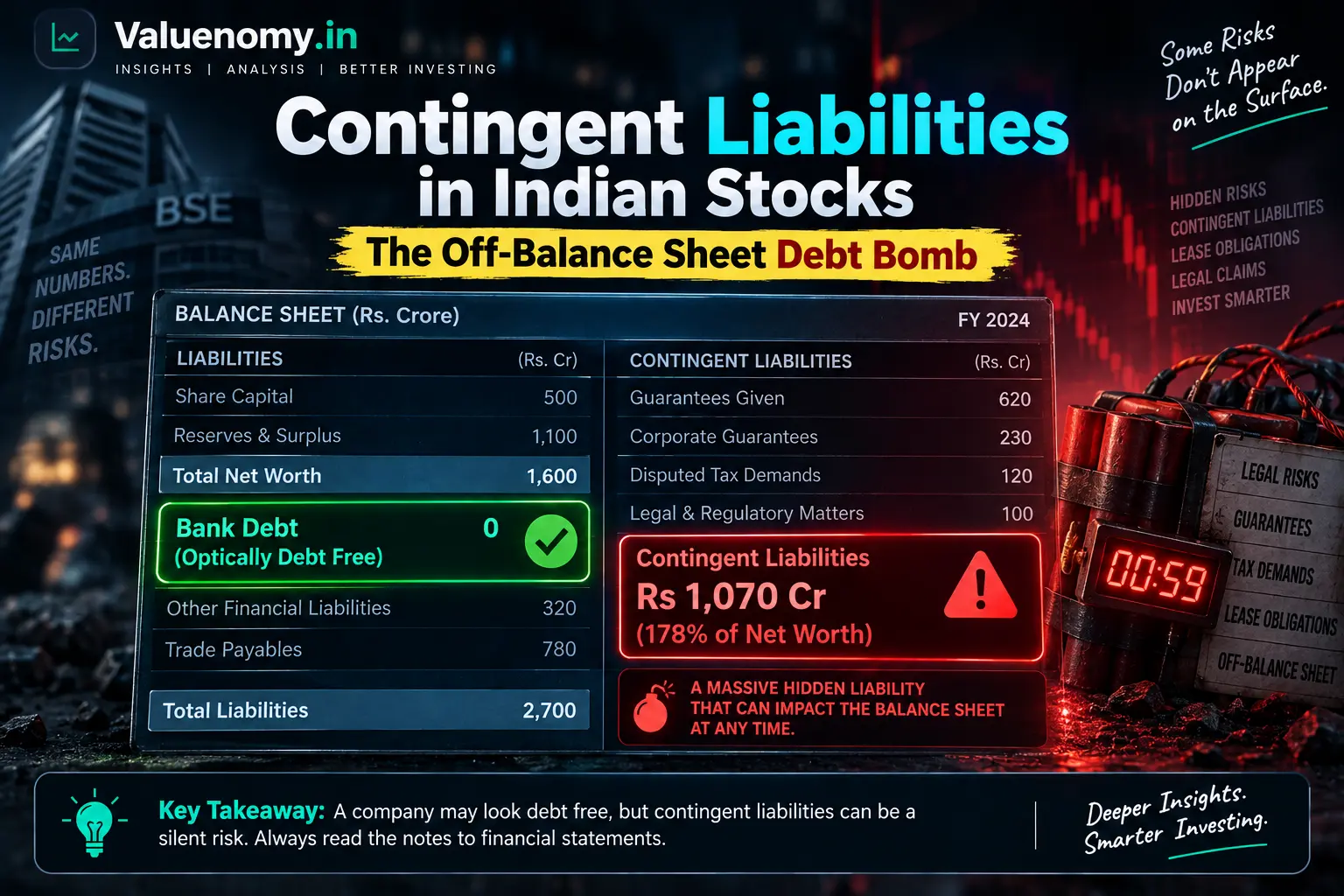
Contingent Liabilities in Indian Stocks: Off-Balance Sheet Debt Bomb
- Valuenomy Research
- Valuation Guides
- 20 Sep, 2026
The Unseen Financial Time-Bomb of Indian Corporates
When studying the balance sheet of companies on Dalal Street, Indian retail investors make a common mistake while analyzing a company’s exposure to debt. They tend to focus only on the bank borrowings of the entity and ignore the far more significant contingent liabilities. As a consequence, many investors have been trapped by the off-balance sheet debt of companies that showed little or no bank borrowings on their balance sheets. This article series will focus on uncovering how Indian corporates hide massive obligations in their annual reports and the impact of such obligations on the valuations of their stocks.
Understanding contingent liabilities
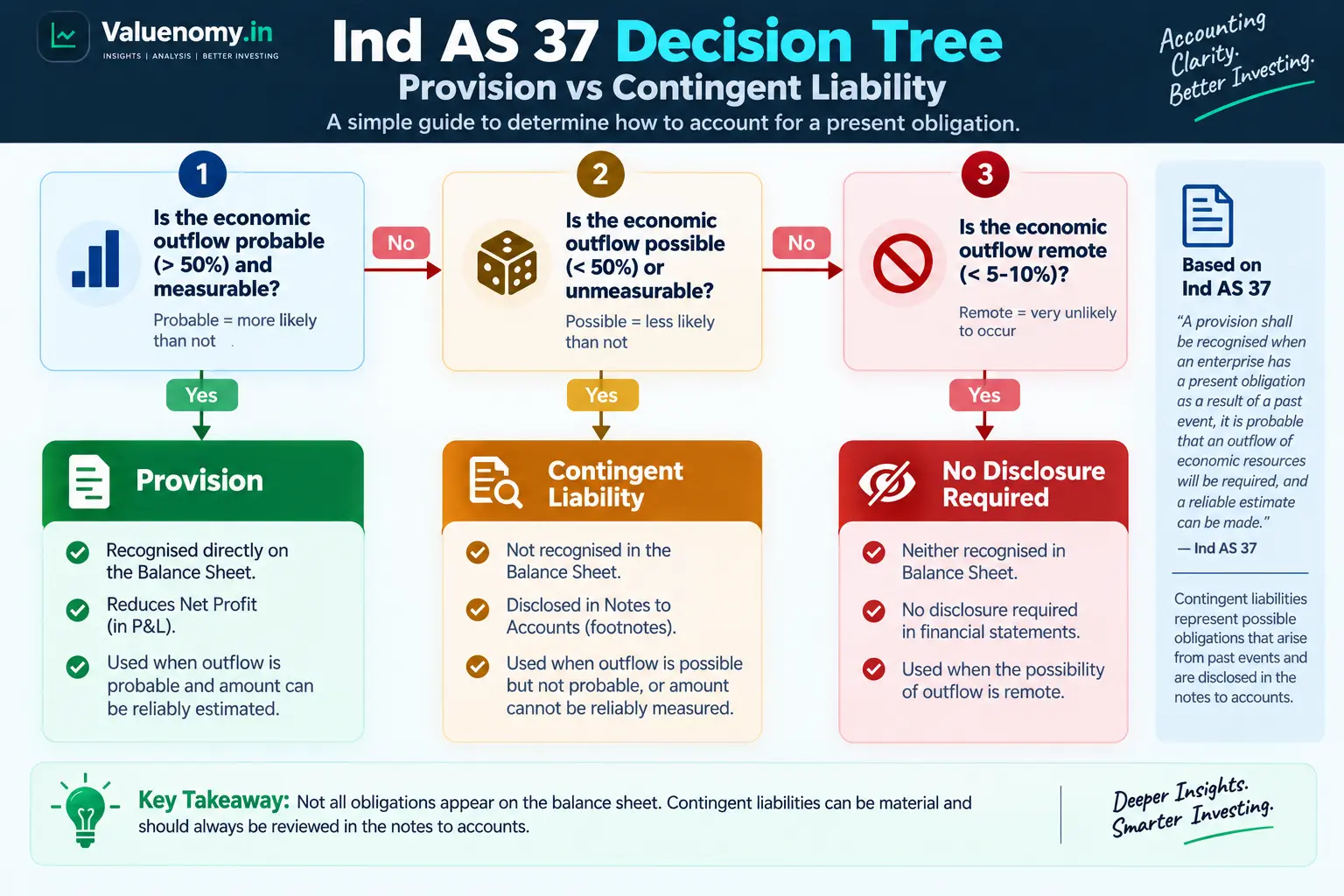
Per Indian Accounting Standard (Ind AS) 37, contingent liabilities refer to obligations that arise from past events and whose settlement is dependent on the occurrence of uncertain future events. According to Schedule III, Companies Act 2013, contingent liabilities that are expected to result in liquidation of assets should be disclosed in the notes to the accounts. A company’s management has the option to put contingent liabilities in the main body of the balance sheet or keep it in the footnotes.
There are three categories of contingent liabilities as per Ind AS 37:
- Provision – It is the amount of liability provided for in the Balance Sheet of the company. According to Ind AS 37, a company has to create a provision directly on the balance sheet when there is a probable (more than 50%) obligation to make a payout. Provisions reduce the net profit of the company.
- Contingent Liability – As mentioned above, liabilities that are not provided for directly on the balance sheet but are noted in the footnotes to the accounts of the company fall under this category. A contingent liability arises when there is a possible obligation that arises from past events and whose settlement depends on uncertain future events. It also arises when the obligation to payout is probable (more than 50% likely) but the amount of obligation cannot be estimated reliably. If there is a remote possibility (less than 5-10%) of a liability, management is not obliged to disclose it in the footnotes or the Balance Sheet.
Management’s estimation of contingent liabilities plays a significant role in hiding obligations from shareholders. There is a high degree of subjectivity in determining whether a potential obligation has a less than 50% or more than 50% chance of occurring. Indian corporate management takes advantage of this subjectivity to keep large contingent liabilities on the sidelines to protect profits and balance sheet valuation of the company.
The 3 main types of contingent liabilities in India
Indian companies generally disclose the following contingent liabilities in the footnotes to their financial statements:
- Contingent liabilities related to guarantees of loans by related parties
- Disputes with tax authorities regarding demand for tax dues by GST, customs, or income tax departments
- Performance guarantees and liquidated damages.
Contingent liabilities related to guarantees of loans by related parties (category 1) are by far the most dangerous from an investor’s perspective. When a promoter-owned entity takes a bank loan, the listed parent company that owns the promoter entity guarantees the repayment of the loan to the lender. The loan liability of the promoter-owned entity appears on its own balance sheet, and the parent company’s only obligation is to note the contingent liability on its own balance sheet if it has guaranteed the loan repayment to the bank.
However, if the promoter-owned entity defaults on the loan, the bank will go after the parent company to recover the entire overdue amount, thereby putting the parent company at risk of being forced into insolvency proceedings.
Controversies with tax authorities (category 2) are also a significant concern for Indian corporates. Companies frequently receive notices from the GST, customs, and income tax authorities about alleged tax liabilities. In most instances, companies fail to set aside provisions for these amounts on the balance sheet and instead indicate them as claims against the company in the footnotes to the financial statements. Although some of these disputed tax demands are routine, if the cumulative amount of unpaid tax demands exceeds 50 percent of a company’s net worth, any adverse judgment against the company in favor of the tax authorities would drain the company’s retained earnings, leaving it unable to meet its obligations to pay dividends to shareholders.
Finally, the third category of contingent liabilities in India – performance guarantees and liquidated damages – causes enormous headaches for companies that guarantee project completion dates to clients. Indian EPC and capital goods companies frequently issue bank guarantees to their clients as a security for their ability to complete a project within the contracted time frame and budget. Once the client detects a delay in project completion, it can demand the bank to encash the guarantee. This, in turn, creates a significant liquidity crisis for the company as the amount of the bank guarantee now appears as a liability on the company’s balance sheet.
The critical forensic metric to analyze contingent liabilities
While calculating the risk associated with contingent liabilities, forensic accountants generally use the ratio of contingent liabilities to net worth.
Forensic Accountants’ Contingent Liabilities to Net Worth Ratio – Benchmark
Contingent liabilities to net worth ratio: This is a critical metric to analyze contingent liabilities in Indian stocks. To determine this metric, forensic accountants take all contingent liabilities mentioned in the footnotes to a company’s financial statements and divide the number by the company’s net worth. According to the ratio, the following classifications apply:
- Less than 20 percent: It is generally normal for companies to have contingent liabilities, with the amount usually ranging from 5 to 20 percent of net worth.
- 20 percent to 50 percent: The level of contingent liabilities is moderate. However, one must analyze whether most of the contingent liabilities are related to disputes with tax authorities or corporate guarantees.
- More than 50 percent: This level of contingent liabilities is highly concerning as it implies that the company has enormous undisclosed liabilities that could jeopardize its solvency if not accounted for.
- Over 100 percent: This indicates a severe solvency risk for the company. If any of the contingent liabilities were to materialize, the company would be bankrupt.
Illustrative example – Comparing the risk of contingent liabilities of two industrial manufacturing companies
To illustrate the example, let’s assume that there are two industrial manufacturing companies on the stock exchange – Company Alpha and Company Beta. Their financial statistics are as follows:
| Financial Statistic | Company Alpha | Company Beta |
|---|---|---|
| Reported long-term bank borrowings | Rs 0 | Rs 150 crore |
| Tangible net worth | Rs 600 crore | Rs 600 crore |
| Profit after tax | Rs 90 crore | Rs 90 crore |
| Reported debt to equity ratio | 0.0x | 0.25x |
| Disclosure of corporate guarantees to related parties | Rs 850 crore | Rs 0 |
| Disclosure of dispute with tax authorities | Rs 220 crore | Rs 35 crore |
| Total contingent liabilities | Rs 1,070 crore | Rs 35 crore |
| Contingent liabilities to net worth ratio | 178 percent | 5.8 percent |
Even though Company Alpha has no bank borrowings on its balance sheet, it has contingent liabilities of Rs 1,070 crore, which is 1.78 times its net worth. On the other hand, although Company Beta has taken a bank loan of Rs 150 crore, the company has contingent liabilities of just Rs 35 crore. Based on the analysis, Company Alpha runs a much higher risk of insolvency due to contingent liabilities than Company Beta.
References
In this article, we have used a number of statutory and regulatory guidelines to examine contingent liabilities in Indian stocks. As such, we felt it was necessary to list the resources we relied on to prepare this article:
The provisions of Indian Accounting Standard (Ind AS) 37 are available at the following link:
The Ministry of Corporate Affairs (MCA) Schedule III Companies Act 2013 can be accessed via the link below
The SEBI Listing Obligations and Disclosure Requirements (LODR) Regulations, 2015, Regulation 30, can be accessed here:
The Reserve Bank of India (RBI) Prudential Norms on Off-Balance Sheet Exposures can be accessed through the link below:
The National Financial Reporting Authority website can be accessed through the link below:
How to determine contingent liabilities in the annual report of a company?
Follow the steps below to determine contingent liabilities in the annual report of a company:
- Step 1: Check the notes to the financial statements of the company
When analyzing a company’s contingent liabilities, it is essential to go through the notes to the financial statements rather than rely only on the summary presented on financial portals. You can download the complete report in PDF format from the exchange website. After downloading, look for the heading “Contingent Liabilities and Commitments.” If you don’t find the heading, look for the word “Commitments” at the end of the document.
- Step 2: Separate guarantees from litigations
In the document, look for the section that separates the items related to guarantees from those related to litigation. Under the headings related to guarantees, look at how much the company has guaranteed loans to related parties or other entities. In the section related to litigation, note the amount of disputes the company has with its customers, suppliers, and other entities.
- Step 3: Determine the adjusted debt to equity ratio
While analyzing a company’s leverage, it is essential to adjust the leverage ratio on the basis of contingent liabilities. In case of guarantees, the amount should be added to the existing amount of debt on the company’s balance sheet to ascertain the true leverage of the company. If the adjusted debt to equity ratio is significantly high, it indicates that the company is highly levered and the risk of default is high.
- Step 4: Read the comments of auditors in CARO 2020
In the CARO 2020 report of a company, auditors comment on whether the management of the company has made provisions for statutory dues not paid due to any dispute. Read the auditor’s report to determine the amounts of dues that the company has not paid and the forum in which the disputes are pending.
- Step 5: Perform the adjusted cash flow analysis
If a company has a large number of contingent liabilities, it may have obligations whose cash outflow is yet to materialize but would impact the company’s equity in the future. To understand the impact of contingent liabilities, retail investors can use the adjusted cash flow analysis to determine the intrinsic value of the company. Adjusted cash flow analysis can be performed using the Valuenomy Fair Value Calculator.
Frequently Asked Questions
Why are contingent liabilities not included in a company’s balance sheet?
The reason contingent liabilities are not included in a company’s balance sheet is that the event causing the liability to materialize is not virtually certain, and the amount of liability cannot be estimated reliably.
Can contingent liabilities push a debt-free company into insolvency?
Yes, contingent liabilities can push a debt-free company into insolvency if any of the liabilities materialize. For instance, if a company guarantees a related party’s loan to a bank, the bank can ask the guarantor company to pay back the overdue amount in case of default by the borrower company. Consequently, the guarantor company will incur huge expenses that can push it into insolvency.
What is a dangerous contingent liabilities to net worth ratio?
The contingent liabilities to net worth ratio of more than 50 percent is considered dangerous. However, a ratio of over 100 percent is considered extremely dangerous.
How do tax disputes become liabilities?
Tax disputes become liabilities when the disputed demand for tax payment is proved to be valid by the appellate tribunal or tax authority.
Where are contingent liabilities mentioned?
Contingent liabilities are mentioned in the notes to financial statements under the heading “Contingent Liabilities and Commitments” as well as CARO 2020.

Valuenomy Research
Capital Markets & Valuation DeskValuenomy Research Desk is comprised of certified financial analysts focusing on DCF valuation modeling, Indian direct taxation analysis, and quantitative equity risk management.
View Editorial Profile & MethodologyRegulatory Compliance & Statutory Disclaimer
The financial models, valuation projections, brokerage summaries, and target estimations presented on Valuenomy are curated solely for academic research, mathematical evaluation, and investor education purposes.
Valuenomy is not a SEBI-registered investment advisor or research analyst. Securities markets are subject to high market risks. Always review underlying corporate filings and consult an authorized SEBI-registered financial advisor before executing capital decisions.