Bonus Stripping and Dividend Stripping in Indian Equities: Section 94 Rules
- Valuenomy Research
- Taxation
- 01 Oct, 2026
Tax Loss Harvesting Through Synthetic Short Term Losses
For high-net-worth individuals, family offices, and active traders on Dalal Street, minimizing tax obligations alongside returns optimization constitutes an important exercise. In the case of large realized short term capital gains, prudent portfolio managers would always look to offset profits with capital losses. Under the provisions of the Income Tax Act, 1961, eligible capital losses can be utilized to offset capital gains, lowering advance tax liabilities as well as final tax payouts.
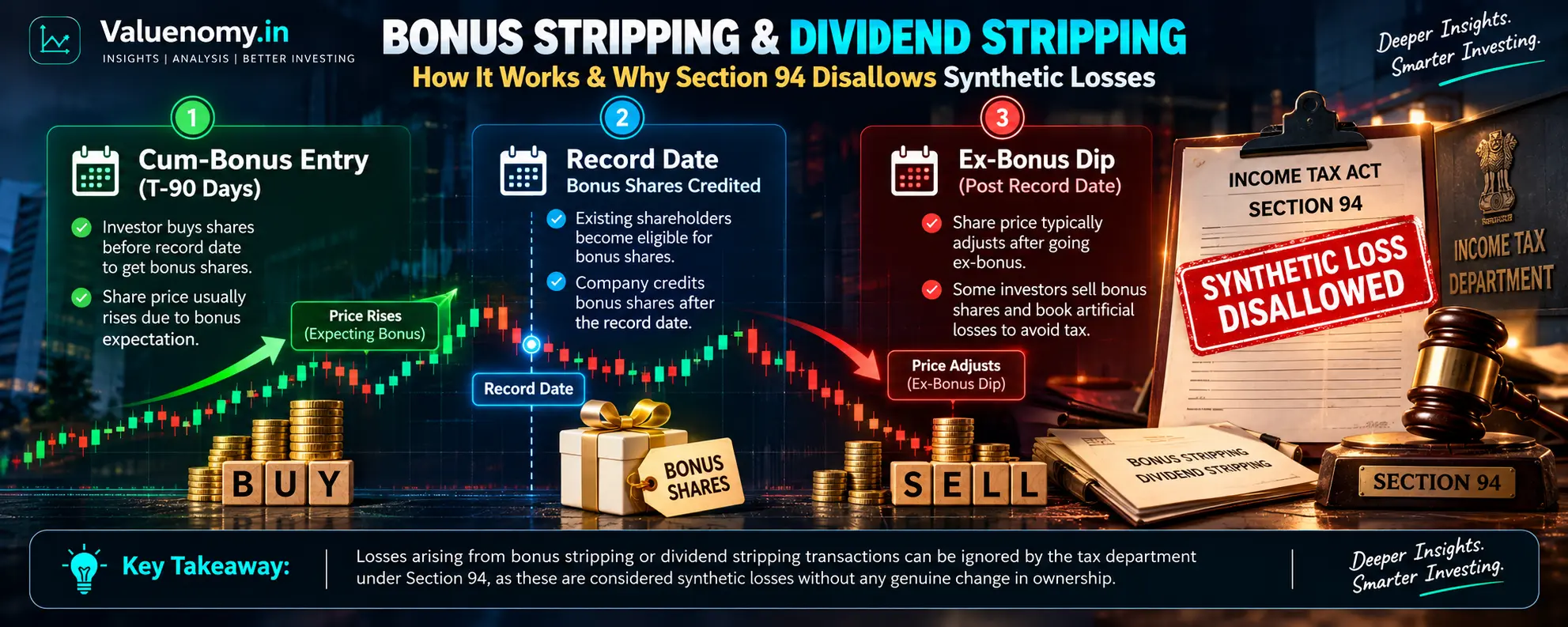
As a result, aggressive tax planners came up with two corporate action based tax avoidance schemes – “dividend stripping” and “bonus stripping”. Instead of taking on the risk of realizing short term capital losses through direct market interventions, market participants would take advantage of the “optical illusion” created by price adjustments on ex-dividend and ex-bonus dates. By purchasing securities ahead of announced corporate actions and selling off the positions on the adjusted price, investors would be able to record artificial short term capital losses while simultaneously realizing tax-free dividends or bonus shares.
To stop the erosion of revenue, CBDT and the Parliament of India created statutory barriers to close the loophole on “dividend stripping” (Section 94(7)) and “bonus stripping” (Section 94(8)). Understanding the working of bonus stripping and the tax loss harvesting scheme involving dividends in Indian equity markets is important for all active portfolio managers.
Corporate Action Based Arbitrage: Why Did Statutory Safeguards Emerge?
To understand why statutory safeguards were needed to prevent dividend stripping and bonus stripping schemes, it is important to understand the working of corporate action price adjustments.
When a listed company declares an interim dividend, the market price on the ex-dividend date drops by virtually the amount of the dividend payout. Similarly, if a company announces a bonus issue of 1:1, the number of outstanding shares increases by 100%, reducing the per share price by exactly 50% on the ex-bonus date.
Before Dividend Distribution Tax (DDT) was abolished under the Finance Act, 2020, dividends distributed by corporations were tax-free in the hands of shareholders under Section 10(34). Under Section 115-O of the Income Tax Act, 1961, DDT was paid at source by the distributing company itself.
Under this system, an investor with Rs 10 lakh taxable short term capital gains would purchase a scrip cum-dividend at Rs 100. By selling the ex-dividend shares at Rs 80, the investor would be able to pocket Rs 20 as tax-free dividend income while recording Rs 20 of short term capital losses to offset capital gains tax liability.
Bonus stripping worked on a similar principle. An investor would buy cum-bonus shares or units, sell the original shares on the ex-bonus date to record short term capital losses, and retain the new bonus shares with zero cost of acquisition under Section 55(2)(aa). This way, the investor was able to create synthetic capital losses to offset current gains while deferring the tax liability on the bonus shares until their eventual disposal.
Statutory Closure on Dividend Stripping Under Section 94(7)
Parliament passed Section 94(7) to close the loop on dividend stripping transactions. Under Section 94(7), a capital loss will be disallowed to the extent of dividend received or income accrued if:
| Statutory Condition | Description |
|---|---|
| Acquisition within 3 months | An investor has acquired any securities or mutual fund units within a period of 3 months prior to the record date. |
| Transfer within 3/9 months | An investor has transferred, sold, or redeemed the same securities within 3 months, or mutual fund units within 9 months, after the record date. |
| Dividend received | An investor has received a dividend or income distribution on the securities that is either exempt from tax or taxed at concessional rates. |
In essence, Section 94(7) prevents a shareholder from utilizing short term capital losses that arose due to selling securities at an adjusted lower price on the ex-dividend date to offset capital gains. The disallowed loss is restricted to the amount of dividend received. Any excess loss beyond the dividend amount is permitted to be carried forward as a genuine capital loss under Section 70 and Section 74 to be set off against future capital gains.
After the Finance Act, 2020, dividend stripping lost significant appeal for individual resident shareholders. With dividends now taxable in the hands of shareholders at slab rates under Section 56(2)(i), individuals pay ordinary income tax on the receipt, and capital losses cannot be set off against dividend income.
Despite this change, Section 94(7) remains operational, covering corporate entities and institutional investors that continue to enjoy concessional tax rates on dividends, or those entering into tax treaties with foreign jurisdictions.
Legislative Evolution of Bonus Stripping Rules Under Section 94(8)
While Section 94(7) covered dividend stripping, bonus stripping continued to be utilized by tax planners. The original text of Section 94(8) only referenced “units” and not “securities” – leaving scope for planning with listed equities. Taxpayers argued that the literal language of Section 94(8) did not prohibit selling original shares on the ex-bonus date to record short term capital losses.
High-net-worth individuals would buy cum-bonus shares of cash-rich listed companies to record short term capital losses on the sale of original shares while retaining bonus shares with zero cost of acquisition. Appellate courts and tax tribunals frequently ruled in favor of taxpayers under strict literal interpretation, noting that because the statute specifically used the word “units,” it did not apply to equity shares.
The Finance Act, 2022 amended Section 94(8) to explicitly apply bonus stripping provisions to both mutual fund units and securities (including listed equities). The revised Section 94(8) operates under the following criteria:
| Statutory Condition | Description |
|---|---|
| Acquisition within 3 months | An investor has acquired any securities or units within a period of 3 months prior to the record date. |
| Allotment without payment | The investor has been allotted additional securities or units (bonus shares) without any payment by virtue of holding the original securities. |
| Transfer within 9 months | The investor has transferred or sold all or any of the original securities within 9 months after the record date while retaining all or any of the bonus shares. |
The rules under Section 94(8) disallow capital loss utilization on the sale of original securities if these conditions are met. Under the statutory mechanism, the disallowed loss is not permanently extinguished; rather, it is deemed to be the cost of acquisition of the retained bonus shares.
Sample Bonus Stripping Transaction in Indian Equity Markets
Let us analyze the working of bonus stripping as well as its tax implications under the amended Section 94(8) rules:
| Transaction Parameter | Details |
|---|---|
| Taxable STCG from swing trades | Rs 10,00,000 |
| Target corporate action | 1:1 bonus issue from Listed Industrial Corp |
| Record date | August 14 |
| Purchase date | August 1 (within 3 months prior to record date) |
| Quantity purchased | 10,000 shares |
| Price per share | Rs 200 |
| Initial total investment | Rs 20,00,000 |
| Bonus shares entitlement | 10,000 bonus shares at Rs 0 statutory cost |
| Ex-bonus price adjustment | Rs 100 per share |
| Disposal date of original shares | September 15 (within 9 months after record date) |
| Price of original shares sold | 10,000 original shares sold at Rs 100 = Rs 10,00,000 |
| Holding of bonus shares | 10,000 bonus shares retained in demat |
Tax computation comparison across regimes:
| Computational Parameter | Old Regime (Prior to Equities in Section 94(8)) | Current Regime (With Amended Section 94(8)) |
|---|---|---|
| Sale consideration of original shares | Rs 10,00,000 | Rs 10,00,000 |
| Less: Cost of acquisition (10,000 x 200) | Rs 20,00,000 | Rs 20,00,000 |
| Calculated short term capital loss | Rs (10,00,000) | Rs (10,00,000) |
| Losses utilized to offset current STCG | Rs 10,00,000 | Rs 0 (Disallowed) |
| Net taxable gains – final assessment | Rs 0 | Rs 10,00,000 |
| Statutory cost of 10,000 bonus shares | Nil (Rs 0) | Rs 10,00,000 (Shifted from disallowed loss) |
| Effective cost per bonus share | Rs 0 per share | Rs 100 per share |
Under the former setup, an investor could offset the entire Rs 10,00,000 of short term capital gains by utilizing the Rs 10,00,000 synthetic short term capital loss. Under amended Section 94(8), the Rs 10,00,000 loss on the original shares is disallowed from current set-off. Instead, that Rs 10,00,000 is capitalized into the cost basis of the 10,000 retained bonus shares, increasing their effective cost basis to Rs 100 per share and deferring any tax shield until those bonus shares are disposed of.
Reference Sources for Tax Compliance on Corporate Actions
| Tax Compliance Authority / Act | Reference Resource URL |
|---|---|
| Income Tax Act, 1961 (Section 94) | https://incometaxindia.gov.in |
| Finance Act, 2022 (Amending Section 94(8)) | https://indiabudget.gov.in |
| SEBI LODR Regulations, 2015 (Record Date Guidelines) | https://www.sebi.gov.in |
| ICAI Guidance Note on Tax Audit (Verification of Disallowed Losses) | https://www.icai.org |
Investor Guidelines Around Bonus Stripping and Dividend Stripping
Investors navigating corporate actions can reference these procedural guidelines:
-
Maintain a 90-Day Buffer Before Corporate Actions: If you intend to invest in a business ahead of an announced corporate action, ensure you account for the 3-month statutory window prior to the record date if secondary rebalancing is planned.
-
Avoid Selling Original Shares Within the 9-Month Period: If you purchase cum-bonus securities and participate in the corporate action, avoid disposing of only the original shares within 9 months after the record date if your intention is to recognize a deductible loss in the current assessment year.
-
Do Not Rely Solely on Unadjusted Brokerage Statements: Standard broker P&L reports often show raw trading losses without integrating Section 94(7) or Section 94(8) disallowances. Before estimating quarterly advance tax liabilities, calculate net taxable gains with appropriate capital gains provisions using Valuenomy's Capital Gains Tax Calculator.
Frequently Asked Questions
What is the purpose of Section 94 in the Income Tax Act?
Section 94 functions as an anti-avoidance provision designed to prevent taxpayers from generating artificial short-term capital losses through timed corporate actions like dividend distributions and bonus share issuances.
Does Section 94(8) apply to listed shares currently?
Yes, the amendment made by the Finance Act, 2022 expanded Section 94(8) to explicitly include securities along with mutual fund units, bringing listed equity shares under the bonus stripping rules.
What happens to the disallowed loss on original shares?
The loss on original shares is not entirely lost; it is capitalized and added to the cost of acquisition of the newly allotted bonus shares. This defers the tax benefit until the bonus shares are sold in the market.
What does Section 94(7) say about dividends?
If an investor buys securities or units within 3 months prior to the record date and sells them within 3 months (for securities) or 9 months (for units) after the record date, any capital loss on the sale is disallowed to the extent of tax-free or concessionally taxed dividend income received.
Can losses be set off if original shares and bonus shares are sold together?
Yes. If all original shares and all bonus shares are sold simultaneously, the transaction reflects the actual net economics of the total position, and capital gains or losses are computed on the combined trade.

Valuenomy Research
Capital Markets & Valuation DeskValuenomy Research Desk is comprised of certified financial analysts focusing on DCF valuation modeling, Indian direct taxation analysis, and quantitative equity risk management.
View Editorial Profile & MethodologyRegulatory Compliance & Statutory Disclaimer
The financial models, valuation projections, brokerage summaries, and target estimations presented on Valuenomy are curated solely for academic research, mathematical evaluation, and investor education purposes.
Valuenomy is not a SEBI-registered investment advisor or research analyst. Securities markets are subject to high market risks. Always review underlying corporate filings and consult an authorized SEBI-registered financial advisor before executing capital decisions.