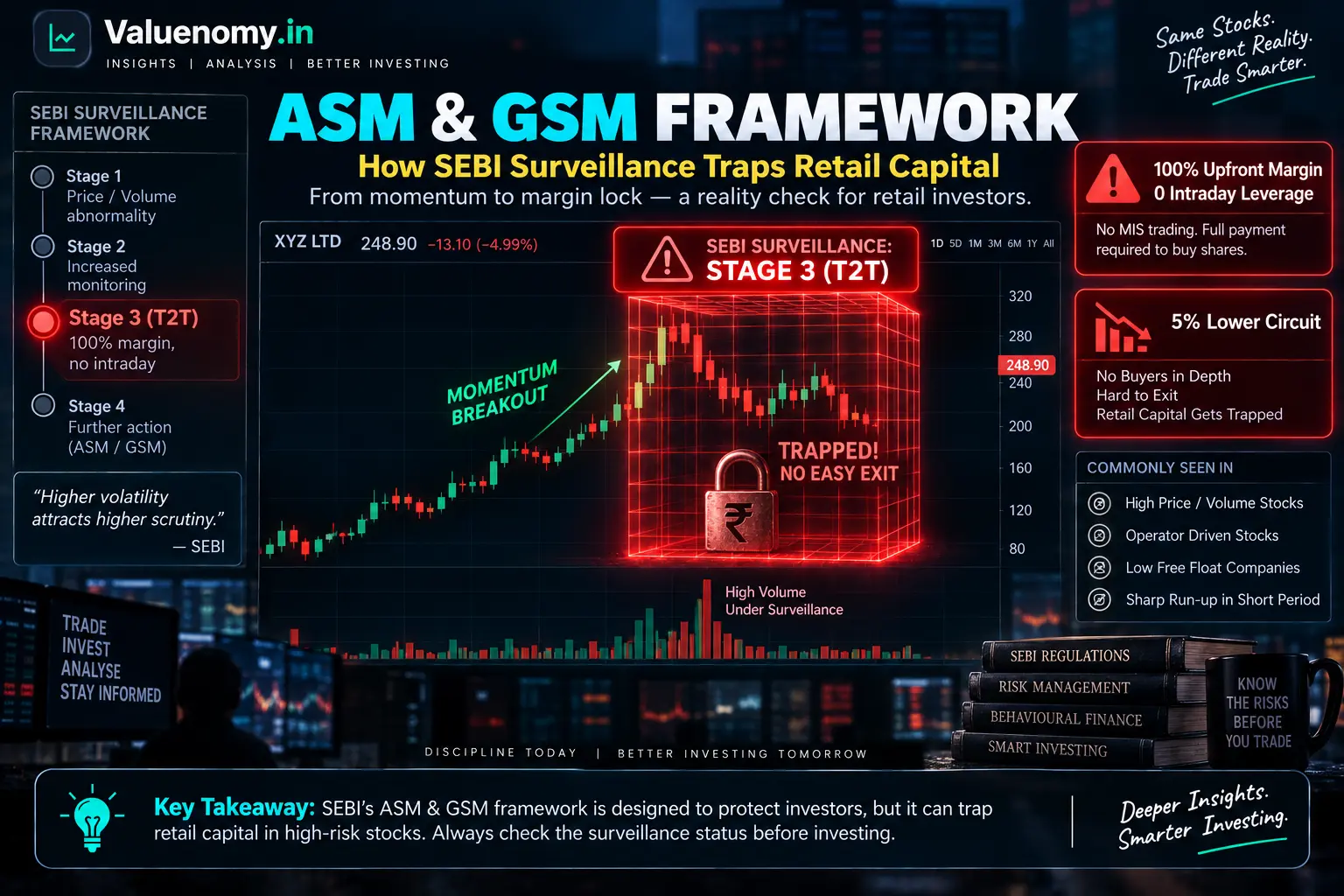
ASM and GSM Framework in Indian Stocks: How Does SEBI Surveillance Trap Retail Traders
- Valuenomy Research
- Regulatory & SEBI
- 23 Sep, 2026
The Illusion of Easy Money
Every trading week in the National Stock Exchange and Bombay Stock Exchange, there is an unpleasant surprise waiting for a retail market participant. A breakout small-cap or penny stock that was flowing nicely in the intraday trade gets suspended due to a block of fresh purchases, demands 100 percent of upfront margin, gets forced into delivery, or goes into weeks of consecutive lower circuits where there are no buyers. Retail investors typically assume that either their brokerage software has crashed or manipulators at the end of the trade have created an artificial dump.
The reality is that a given stock has entered the surveillance lists prepared by the Securities and Exchange Board of India and stock exchanges called the Additional Surveillance Measure (ASM) and Graded Surveillance Measure (GSM).
While the aim stated by the regulator to create extra caution amongst investors, stop rampant speculation, improve price discovery, and prevent artificial rigging is indeed applaudable, the mechanical nature of the surveillance systems creates the exact opposite effect. Retail participants get trapped with a rapid lowering of liquidity, extreme margin demands, dramatic compression of the price band, and ultimately a lower circuit trap where capital gets stuck for months.
Understanding how the Indian stock exchanges work, what are the mathematical triggers, and stages of surveillance for the ASM and GSM framework in Indian stocks is critical to taking these risks into account before speculating with fresh funds in momentum, small-cap, or turnaround stocks.
The Big Picture: What Does the Surveillance Look For?
Despite the common misconception, the Additional and Graded Surveillance Measures have entirely different purposes and monitor divergent dimensions of a company.
While ASM primarily watches the trading of a security and not its fundamentals, the GSM looks at whether the Price-to-Earnings or Price-to-Book Valuation has moved away from the underlying reality of a firm’s balance sheet.
A fundamentally strong business with excellent cash-generation capabilities and positive numbers on its income statement can still get caught in the ASM lists if its underlying share price shows a massive inter-day swing or its daily volumes surge to a degree that suggests institutional involvement with a low percentage of deliveries and heavy client concentration. Meanwhile, a financially weak small-cap with a tiny balance sheet and large P/E ratios will find itself in the GSM framework if its share price undergoes a multi-fold expansion unsupported by physical assets on the ground.
In other words, while the Additional Surveillance Measure observes speculative price swings and client inflows/outflows, the Graded Surveillance looks at the health of a company’s books to ensure its stock price roughly reflects its fair value. Either way, these regulatory mechanisms ultimately lower the liquidity of a security, often with brutal mechanical precision.
Surveillance Parameters and Entry Filters
There are objective mathematical filters an equity must meet before getting placed in either of the two lists.
For the Additional Surveillance Measure guidelines, there are two sets of rules – one for the Short-Term ASM and another for the Long-Term variant. According to the guidelines released by the National Stock Exchange of India and Bombay Stock Exchange, a security will enter the Short-Term ASM framework if (a) the closes-to-closes 5-day and 15-day absolute price variation is more than 25% to 40% (based on the beta of the scrip vis-à-vis the Nifty 500 Index or other relevant indices), and (b) the top 25 clients are contributing to more than 30% of the daily turnover in volumes.
Another filter that could trigger a Short-Term ASM placement is if there is a greater-than-75% price variation between the one-month high-low and fewer than 50 PAN clients are taking delivery.
Meanwhile, a stock will get added to the Long-Term ASM list if (a) the 3-month absolute price variation is over 150%, (b) volumes have surged more than 5X its 3-month average daily turnover, (c) the delivery value is under 50% of the total turnover, and (d) top-tier client concentration is present.
Furthermore, if an equity has a 200% close-to-close price swing in its daily trade over the preceding 365 days with huge volatility, it shall go directly to the last stage of Long-Term ASM.
As for the entry filters of the Graded Surveillance Measure, a company shall enter GSM if either of the two tests is satisfied:
-
Test 1 – The tangible net worth (i.e., equity share capital plus reserves and surplus minus debit balance in the profit and loss account) is less than or equal to INR 10 crores and the net fixed assets (tangible assets plus capital work-in-progress) are less than or equal to INR 25 crores and the P/E is negative or more than twice the P/E of the relevant benchmark index (Nifty 500),
OR
-
Test 2 – The aggregate market capitalization of an equity is less than INR 25 crores and the P/E is more than twice the P/E of the relevant index or the P/B is negative or more than twice the P/B of the relevant index.
The parameters are different for the SME Exchange segment. An equity will enter the GSM framework if (i) the net worth is less than INR 5 crores, (ii) the net fixed assets are less than INR 10 crores, and (iii) the market capitalization is less than INR 10 crores.
Stages and Capital Restrictions for SEBI Surveillance in EQUITIES
Upon meeting the criterion, an equity shall enter a progressive stage-based restriction regime that further constricts trading liquidity.
Long-Term ASM Stages:
-
Stage 1 – Upfront margin requirements shall be increased to 100% for all non-intraday trades, and the price band may be compressed.
-
Stage 2 – The additional margin will continue to be 100%, and the security will be placed in the Trade-to-Trade (T2T) settlement on every transaction. This means that all purchases must be delivered as full physical settlement with no intraday squaring of positions.
-
Stage 3 – The T2T delivery requirement will continue, and the price band shall further compress to 5%.
-
Stage 4 – Trading shall be restricted to 2% or 5% bands, mandatory T2T settlement, and a cooling-off period will be introduced before exiting the surveillance.
GSM Stages & Additional Surveillance Deposit:
One especially brutal feature of the Graded Surveillance is the Additional Surveillance Deposit (ASD) that requires buyers to pay 50% to 200% of the trade value upfront and keep it blocked with the clearing corporation for up to five months.
The stages for GSM are as follows:
-
Stage 1 – 100% upfront margin and a compressed price band of 5% or lower shall be introduced.
-
Stage 2 – Placing the scrip under the Trade-to-Trade (T2T) delivery requirement with a 5% price band and 50% of the gross value of each trade as an Additional Surveillance Deposit.
-
Stage 3 – T2T delivery and 5% daily price band regime continue, but trading shall only be permitted on every Monday or the first trading day of the week with the Additional Surveillance Deposit for buyers at 100%.
-
Stage 4 – Same conditions for trading as in Stage 3, and the Additional Surveillance Deposit is at 200% of the value for each trade. Calls for tenders of shares will only take place at weekly intervals.
The Retail Liquidity Vortex: Why These Mechanisms Hurt Small Investors
When an aggressive regulatory system runs into retail trading psychology, the resulting capital trap is often devastating for small-time market participants. Listed below are the sequential stages of such a trap:
1. The Leverage Strike
Anyone with an intraday position or a margin product (such as MTF products from a broker) will witness their buying power wiped out overnight if they have purchased a security under the Additional Surveillance Measure or Graded Surveillance. As soon as an equity enters ASM Stage 1 or GSM, your brokerage platform will remove all MIS, Cover, and Bracket Products from this scrip. Pledging of your shares of the company as margin collateral will also get canceled, triggering a margin call or forced square-off of other open positions.
The suddenness with which a security could get banned from intraday trading means that not a single retail trader or institutional player has time to calculate the exit or hedging strategy.
2. Buyers Strike
Due to the sharp increases in upfront margins and Additional Surveillance Deposit (ASD) amounts, buyers get wiped off the depth chart. When a Graded Surveillance security enters Stage 2 of the restrictions, no rational institutional or algorithmic player will bid for the stock. If they wish to purchase the shares, they must deposit an extra 50% of the total value of the trade over and above the regular brokerage. Worse still, this 50% will have to remain locked interest-free with the exchange-clearing house for up to five months as a penalty. A sane investor will not risk 300 rupees to purchase 100 worth of equity with 200 free with the stock exchange.
3. Lower Circuit Vortex
Since institutional buyers have completely disappeared due to the Additional Surveillance Deposit and speculative buyers will get their intraday positions blocked (due to the margin requirements), the only persons left to buy are desperate retail investors. With the compressed daily price bands at 5% or 2%, a stock enters a lower circuity on the first day of trading. Retail sellers will post lakhs of orders at the bottom of the market depth, but no buyers will appear to meet their sell-volume.
It works like a perfect lower-circuit vortex trap. Retail market participants have neither the capital (due to the increase in margin requirements) nor liquidity (due to zero buyers on the depth chart) to sell out on the first day of Stage 1 for either of the SEBI frameworks.
4. Lock-in Period
Most blue-chip stocks placed inside the Long-Term ASM or Graded Surveillance continue to reside in the system for more than 90 days before getting downgraded to a lower level of surveillance or exiting completely. As a result, even if the price fluctuations for an equity ease down, the retailer will not be able to exit until a later trading session or after one of the specified review dates.
The difference between a retail trader on the fence and a patient institutional buyer can get swallowed up by the surveillance system with brutal mechanical precision. On one side, there is a desperate seller, and on the other side, no buyers. This is the lower circuit vortex trap.
A Case Study: Comparative Analysis
| Parameter | Company Profile Alpha (Mid-Cap Compounded Growth Stock) | Company Profile Beta (Micro-Cap Turnaround) |
|---|---|---|
| Framework Category | Short-Term ASM | GSM Stage 3 |
| Market Cap | Rs 4,500 crore | Rs 18 crore |
| Balance Sheet / Fundamentals | 32% Revenue Growth; strong earnings guidance | Net worth: Rs 2.5 crore; Net Loss: Rs 4 crore; no fixed assets |
| Surveillance Details | High 5-day absolute price variation and high client concentration | Significant price jump on operator social media rumors |
| Liquidity Impact | Daily volumes reduced by 40%; intraday leverage removed | Buyer demand vanished due to ASD; 24-day lower circuit vortex (5%/day) |
| Retail Liquidity Impact | Normal trading continued throughout the period | Zero sell-side volumes during the first five months of the circuit |
| Exit Scenario | Exited after 15 days of restricted trading with no lasting damage | Locked for 5 months; value of a single share declined by 72% |
Regulatory References
The rules for imposing additional restrictions on shares placed within Additional and Graded Surveillance Measures are detailed in the following documents:
-
Comprehensive Master Circular for Stock Exchanges and Clearing Corporations issued by the Securities and Exchange Board of India (SEBI)
-
Surveillance Rules and Master Lists issued by the National Stock Exchange of India
-
Graded Surveillance Circulars issued by the Bombay Stock Exchange
-
Advances against Shares and NBFC Margin Funding Directions issued by the Reserve Bank of India (RBI)
Institutional references:
Screening and Protection Protocols for Retail Traders
- Protocol 1: Know the Daily Series Before Buying
Never take a position in a breakout, momentum, or small-cap stock unless you download the NSE or BSE CSV master files on the Additional and Graded Surveillance. By scanning the evening circulars, you must ensure that the equity you are buying is going to stay on the lists or it is about to enter a stage downgrade.
- Protocol 2: Monitor the Broker Series Codes
Watch for series codes. A scrip witnessing a change in EQ to BE identifiers is heading toward a sharp drawdown or entering the Trade-to-Trade (T2T) regime because its net worth has crossed a pre-determined threshold.
- Protocol 3: Backtest the Concentration Ratio
Use the block-deal and bulk-deal reports of the NSE and BSE to track whether a significant chunk of daily volumes is driven by a small set of clients. If the trading price of an equity appears to explode on the daily chart due to heavy volumes, and the delivery value is large, then it will likely enter the Short-Term ASM soon.
- Protocol 4: Avoid Averaging Down Positions
When a security enters Stage 2 or 3 of the Graded Surveillance, don’t attempt to average down your position costs. With the weekly trading and Additional Surveillance Deposit requirements, you will not be able to average down your costs. Instead, utilize Valuenomy’s Stock Average Calculator to see what your average entry price is for the position. While Valuenomy’s Fair Value Calculator can help you stress-test if the security even has value, many small-cap turnaround stocks with large P/E ratios get placed inside the GSM and ASM frameworks because their fundamental realities have little connection to their fair price.
Frequently Asked Questions
What can a fundamentally sound company enter the ASM list?
Yes. It is entirely possible for a company that appears fundamentally healthy to enter the Additional Surveillance Measures lists. These restrictions target abnormal absolute price variations and unusual trading patterns. While such stocks appear strong on paper, speculative inflow of funds can push a healthy business far above its intrinsic value.
What happens to dividend, bonus, and corporate actions when a stock enters ASM/GSM?
Dividend, bonus, stock-splits, and corporate actions continue to be processed and paid to shareholders on a normal schedule even if securities lie within the additional restrictions imposed by either of the frameworks.
What is the Additional Surveillance Deposit (ASD)?
The Additional Surveillance Deposit is the amount of money that a buyer must pay additionally to the broker when purchasing a share placed under a Graded Surveillance. The deposit amount ranges from 50% to 200% of the value of the trade and remains blocked with the clearing house for up to five months as punishment.
How long does a stock stay in Long-Term ASM?
While a stock placed inside the Long-Term ASM could potentially remain there for more than 90 days, it will get reviewed every week to determine if it can move to a lower stage or exit the additional restrictions.
Can intraday trades be taken on “BE” series stocks?
Intraday trades or positions cannot be carried on “BZ”, “BE”, or “EZ” series stocks. Any purchase will require you to have the funds in your trading account, and any sale will require you to have the shares in your Demat account. No squaring of positions or intraday trades shall be allowed with such shares due to the additional requirements of upfront margins.

Valuenomy Research
Capital Markets & Valuation DeskValuenomy Research Desk is comprised of certified financial analysts focusing on DCF valuation modeling, Indian direct taxation analysis, and quantitative equity risk management.
View Editorial Profile & MethodologyRegulatory Compliance & Statutory Disclaimer
The financial models, valuation projections, brokerage summaries, and target estimations presented on Valuenomy are curated solely for academic research, mathematical evaluation, and investor education purposes.
Valuenomy is not a SEBI-registered investment advisor or research analyst. Securities markets are subject to high market risks. Always review underlying corporate filings and consult an authorized SEBI-registered financial advisor before executing capital decisions.